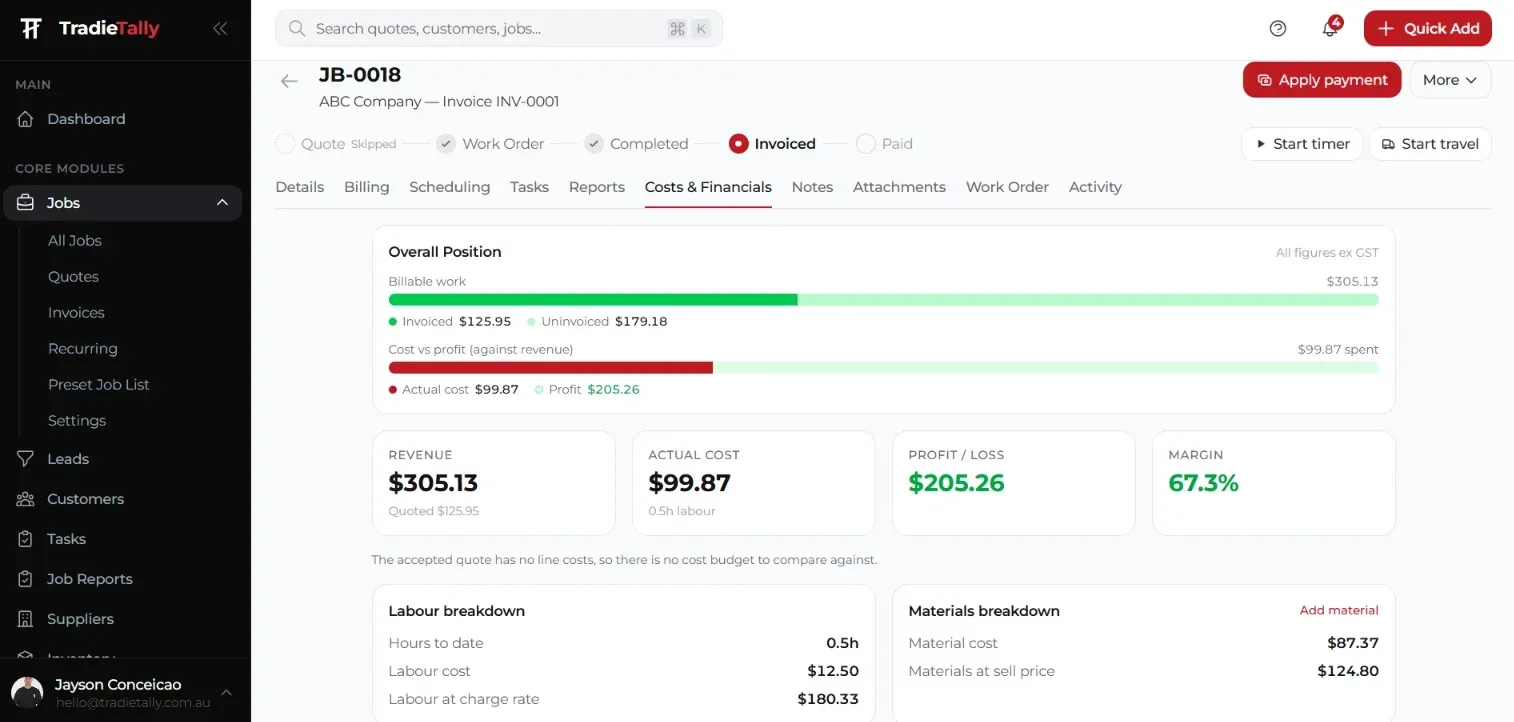
Plenty of trade businesses buy “job management software”, start using its quote screen, and assume they now have estimating covered. Others buy a dedicated estimating tool and then run jobs out of a whiteboard and a group chat. Both setups leave gaps. Here is what each type of software actually does, where they overlap, and how to decide what your business needs.
What is estimating software?
Estimating software helps you work out what a job will cost you and what you should charge, before you send the quote. It deals with labour hours, productivity, materials, running costs, charge-out rates and margin, and turns all of that into a price.
Good estimating software for trades typically includes:
- Material, labour and custom line items with markup or margin
- A charge-out rate built from real business costs, not a guess
- Pre-built job packages for common work, so you are not starting from scratch
- Supplier price lists so material costs stay current
- Profit and margin shown on the quote before it goes out
- Quote templates, versioning and sending
What is job management software?
Job management software runs the job once it is won. It handles scheduling, assigning staff, timesheets, job notes and photos, purchase orders, status tracking and invoicing. Many products in this category, sometimes called field service management, include a simple quote builder, but the focus is on running work, not pricing it.
Typical job management features:
- Jobs created from accepted quotes
- Calendar, scheduling and staff assignment
- Mobile app for field staff with timesheets, checklists and photos
- Purchase orders and stock
- Job status workflow through to invoicing
- Accounting integration and payments
What are the key differences?
| Estimating software | Job management software | |
|---|---|---|
| Main question it answers | What should I charge? | What is happening on this job? |
| When you use it | Before the job is won | After the job is won |
| Main users | Owner, estimator, office | Owner, office, field staff |
| Key inputs | Labour hours, materials, running costs, margin | Schedules, timesheets, purchases, job notes |
| Key output | An accurate, profitable quote | A completed, invoiced job |
| Cost of getting it wrong | Every job is under-priced from the start | Missed jobs, lost hours, slow payment |
| Typical quoting depth | Deep: rates, productivity, margin | Often a basic line-item quote form |
Why does estimating come first for electricians, security techs and A/C installers?
Job management can only manage the number the estimate gave it. If the quote was too low, perfect scheduling and fast invoicing just get you to a loss more efficiently. That is why I built TradieTally as an estimating platform first, with job management built in.
Electricians
Electrical work ranges from a double GPO to a full switchboard upgrade or EV charger install. Labour varies a lot by job type, and a charge-out rate that does not account for lost days and admin time quietly drains profit. The charge-out rate calculator shows how much difference real billable hours make.
Security technicians
Security jobs combine hardware the customer can price online with labour, programming and commissioning they cannot see. If your estimate does not separate those clearly and protect margin on the labour side, you end up competing on camera prices. Recurring work like annual service visits also needs to be priced properly from the start.
Air conditioning installers
A/C quotes live or die on the extras: pipe metres, duct cover, condensate, access and electrical. A base install price with no structure for extras is how a “simple” install turns into a day and a half.
When do you need both?
You need both estimating and job management once any of these are true:
- You have at least one employee or subcontractor in the field.
- You quote a mix of small service jobs and larger installs.
- You want to compare what a job was quoted at with what it actually cost.
- You are re-typing quotes into jobs, then jobs into invoices.
- You cannot easily answer “which jobs made money last month?”
The question then is whether to run two separate systems or one. Two systems can give you specialist depth on each side, but you pay for double entry, two subscriptions and numbers that drift apart. One system keeps the estimate, the job and the invoice connected, so budget vs actual actually works.
What happens when estimating and job management are disconnected?
Here is a common pattern. The owner prices a job in a spreadsheet or a separate estimating tool. The accepted price gets typed into the job management system as a single line. The team goes out, logs their hours and buys materials. The invoice goes out for the quoted amount.
Nobody ever compares the hours and materials the estimate allowed with what the job actually used, because the estimate lives somewhere else. So the same under-priced job gets quoted the same way again next month.
When the estimate and the job sit in one system, the labour hours and materials from the quote become the job’s budget. Timesheets and purchase orders fill in the actual side as the job runs. At the end you can see, line by line, where the job made or lost money, and fix the price next time.
A simple example: a job estimated at 12 labour hours takes 16. If you only see the final invoice, it looks like a normal job. If you see budget vs actual, you know that job type needs four more hours in the estimate, and you update your pre-built package so every future quote is right.
Do I need estimating software if I already have job management software?
Check your current tool against these questions:
- Does it calculate a charge-out rate from your running costs, or just store a number?
- Does it show profit and margin on each quote before you send it?
- Does it warn you when costs push a job below your target margin?
- Can you build and reuse pre-priced job packages for your trade?
If the answer to most of those is no, you have quoting, not estimating. Our buyer’s guide to estimating software for electricians compares how the main Australian options handle this.
How does TradieTally combine estimating and job management?
TradieTally is Australian estimating software with job management built in, made for electricians, security technicians and air conditioning businesses.
- Estimating: the estimating features include a charge-out rate calculator, markup and margin on every line, margin warnings, and Smart Bundles for common trade jobs.
- Quote to job: one click turns an accepted quote into a job, with full cost tracking and budget vs actual.
- Job management: the job management features cover scheduling, a status workflow from Draft to Invoiced, purchase orders, files and photos, and a field app on iPhone and Android.
- Invoicing: invoices come from the job, with Stripe payment links and Xero sync.
Field staff see their jobs, timesheets and checklists, while profit, margins and charge-out rates stay hidden unless you grant access. You can see how it fits your work on the pages for each trade TradieTally supports, or take a look at the TradieTally landing page and current offer.
Key takeaways
- Estimating software answers “what should I charge?”. Job management software answers “what is happening on this job?”.
- A basic quote form in job management software is not the same as estimating.
- Estimating comes first because every later step inherits the quote’s numbers.
- Most electrical, security and A/C businesses with staff or varied work need both.
- One connected system avoids double entry and makes budget vs actual reliable.
If you want estimating and job management in one place, TradieTally plans start at $79/month inc GST, with estimating and job management included. See the pricing page or start your 21-day free trial with no credit card.