Electrical estimating is where an electrical business makes or loses its money. Two sparkies can do the same job, to the same standard, in the same time, and one walks away with a healthy profit while the other works for nothing. The difference is almost always in the estimate. Here’s the process I use, step by step.
Step 1: Define the scope on site
Before you price anything, be clear on exactly what you’re doing. Write it down in plain English, because that scope becomes part of the quote.
- What’s being installed, replaced or tested?
- Where? Ceiling space, under floor, slab, external wall, switchboard location
- What’s excluded? Making good, patching and painting, permits, supply authority fees
- Access issues? Two-storey, tight roof space, heritage ceilings, occupied premises
- Is the existing installation compliant, or will you find problems once you open it up?
Take photos. They save a return trip and back up your scope if there’s a dispute later.
Step 2: Do a materials take-off
List every item: cable by type and length, fittings, accessories, protection devices, enclosures, conduit, fixings and consumables. Then price each one from your current supplier price list, not from memory. Wholesaler prices move, and an estimate priced on last year’s numbers is already under water.
In TradieTally, supplier price lists import by CSV, so the cost price on each material is current. Consumables are allowed for as a percentage, so the small stuff isn’t forgotten.
Step 3: Estimate labour hours task by task
Don’t estimate the whole job as “about a day”. Break it into tasks and allow time for each.
| Task (example) | Qty | Hours each | Hours |
|---|---|---|---|
| Install double GPO (accessible wall) | 4 | 0.75 | 3.0 |
| Install LED downlight (accessible ceiling) | 10 | 0.3 | 3.0 |
| New circuit and RCBO at board | 1 | 1.0 | 1.0 |
| Testing and certification | 1 | 1.0 | 1.0 |
| Set-up, travel and clean-up | 1 | 1.0 | 1.0 |
| Total labour | 9.0 |
Example figures for illustration. Use times from your own completed jobs.
Then adjust for the site: add time for difficult access, occupied homes, old wiring or a second storey. If you track actual hours on every job, your own history becomes the best estimating data you have.
Step 4: Price labour at a real charge-out rate
Your charge-out rate isn’t your wage plus a bit. It has to cover your wage or your staff’s wages and on-costs, plus the ute, insurance, tools, phone, software, accounting and the hours you can’t bill, such as quoting, admin, rain days and public holidays.
Work it out from real numbers with the charge-out rate calculator. Most sparkies who do this for the first time find their rate was too low.
Step 5: Add markup to materials and check the margin
Add markup to your material cost so materials earn a return, not just pass through. Then look at the margin on the whole job, not just the markup percentage. Markup and margin aren’t the same number: a 25% markup is only a 20% margin. Read markup vs margin for tradies if that’s new.
Step 6: Check the profit before you send
Before the quote goes out, check three things:
- Total cost: labour at cost plus materials at cost
- Price ex GST: what the customer pays before GST
- Profit and margin: is it at or above your target?
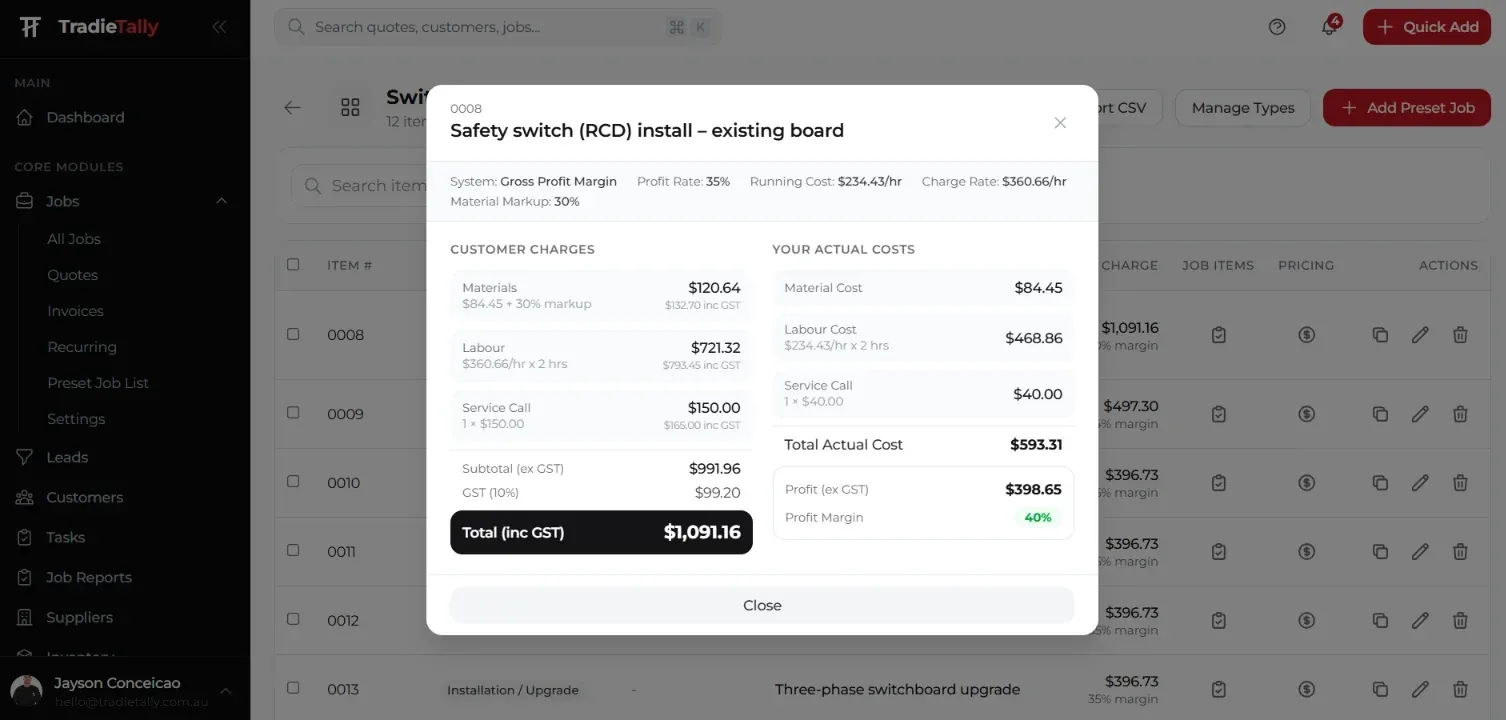
If the margin’s too thin, fix the estimate before you send, not after the job’s done. TradieTally shows cost, profit and margin on every quote and warns you when the margin’s below your target.
Step 7: Turn common jobs into Smart Bundles
The first time you estimate a job type properly, save it. A Smart Bundle (preset job) in TradieTally holds the materials, labour, consumables and margin for a job like an RCD upgrade, a downlight install or an EV charger. Next time you’re on site, you add the bundle, adjust the quantities and send the quote before you leave the driveway.
How does electrical estimating software help?
Spreadsheets work until they don’t: a broken formula, an old price list or a forgotten labour line can wipe out a job’s profit. Electrical estimating software keeps the steps above consistent on every quote.
TradieTally is built by sparkies for the trade:
- Charge-out rate built from your real running costs
- Supplier price lists by CSV import
- Smart Bundles for common electrical jobs
- Profit, margin and markup on every quote before you send it
- Accepted quotes become jobs, tracked budget vs actual
That’s estimating priced for profit on your real numbers, not guessing. Try it free on your next job.
Electrical estimating checklist
- Scope written in plain English, with exclusions
- Site photos taken
- Every material listed and priced from a current price list
- Labour broken into tasks, with site allowances
- Labour priced at a charge-out rate built from real costs
- Markup on materials, margin checked on the whole job
- Profit checked before sending
- Job saved as a Smart Bundle for next time
Key takeaways
- Estimate task by task, not “about a day”.
- Price labour at a charge-out rate built from real costs, and materials from a current price list.
- Check profit and margin before the quote goes out.
- Electrical estimating software like TradieTally makes this repeatable on every job.