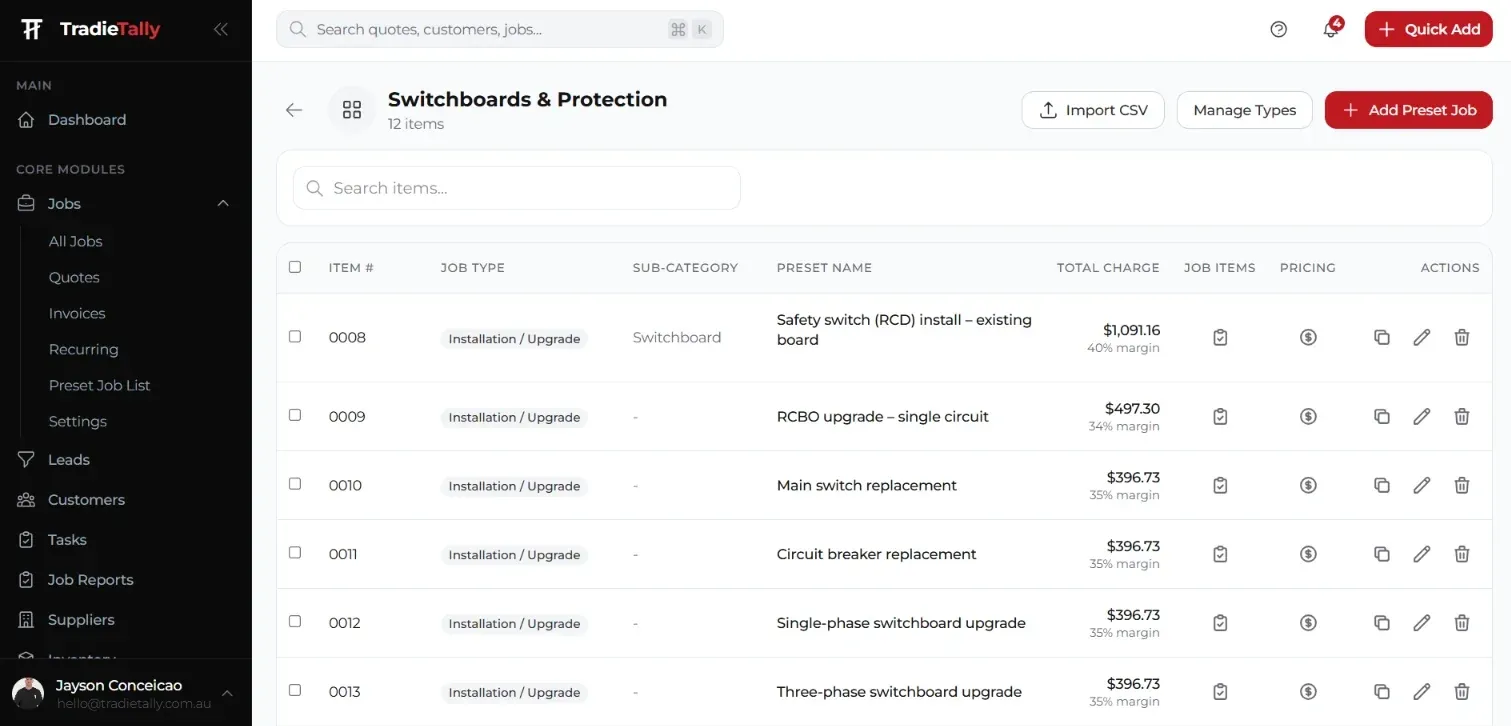
I’ve made most of these mistakes myself. They’re the reason I built TradieTally. Each one looks small on a single quote, but repeated across a year of jobs it’s the difference between a business that pays you properly and one that just keeps you busy.
1. Guessing your charge-out rate
Plenty of sparkies set their rate by asking around or matching the bloke down the road. But his costs aren’t your costs. Your rate has to cover your wage or your staff’s wages and on-costs, plus the ute, insurance, tools, phone, software and accounting.
Fix: build your rate from your real running costs with the charge-out rate calculator.
2. Forgetting the hours you can’t bill
There are 52 weeks in a year, but you won’t bill 52 weeks of hours. Public holidays, annual leave, sick days, rain days, quoting, travel, wholesaler runs and admin all come out of billable time. If your rate assumes you bill eight hours a day, every day, it’s too low.
Fix: use realistic billable hours when you work out your rate. TradieTally’s calculator accounts for this.
3. Pricing materials from memory
Wholesaler prices change. If you price from last year’s numbers, or from what you think a part costs, you lose margin on every job before you start.
Fix: price from a current supplier price list. TradieTally imports price lists by CSV, so your cost prices stay current.
4. Estimating labour as one lump
“About a day” isn’t an estimate. Lump-sum labour hides the tasks that always take longer: testing, fault-finding, difficult access and clean-up.
Fix: estimate task by task, with site allowances. See how to estimate electrical jobs.
5. Confusing markup and margin
If you want a 25% margin and add 25% markup, you’ve only made 20%. On a $2,000 job that’s $100 gone, on every job.
Fix: know the difference. Read markup vs margin for tradies, and use software that shows both on the quote.
6. Sending the quote without a profit check
Most quoting apps show you a total. Very few show the profit. If you can’t see what a job makes before you send it, you’ll find out after, when it’s too late.
Fix: check cost, profit and margin on every quote. TradieTally shows them on every quote and warns you when the margin’s below your target.
7. Never comparing the estimate with the actual job
If you never check how many hours a job really took, your estimates never improve. You keep making the same under-allowance on the same job type.
Fix: track budget vs actual on every job. See job costing for electricians.
How does electrical estimating software prevent these mistakes?
Electrical estimating software builds the fixes into every quote, so they don’t depend on remembering them at 9pm at the kitchen table.
| Mistake | How TradieTally fixes it |
|---|---|
| Guessed charge-out rate | Rate built from your real running costs |
| Forgotten non-billable hours | Realistic billable hours in the calculator |
| Materials from memory | Supplier price lists by CSV import |
| Lump-sum labour | Smart Bundles with labour per task |
| Markup vs margin confusion | Markup and margin shown on every quote |
| No profit check | Cost, profit and margin before sending, with margin warnings |
| No budget vs actual | Jobs tracked against the estimate |
TradieTally is built by sparkies for the trade: estimating priced for profit on your real numbers, not guessing. Start your free trial and re-price your three most common jobs. Most sparkies find at least one that’s been losing money.
Key takeaways
- Build your charge-out rate from real costs and realistic billable hours.
- Price materials from a current price list and labour task by task.
- Know the difference between markup and margin.
- Check profit before sending and compare every estimate with the actual job.